Building EV Hardware To Solve Installation Problems
I fell into starting an EV charging company, not because I wanted to start a new company, but because I wanted to solve problems that would be monumental to humanity's sustainable future.
The story that most people know about Orange is a cheeky anecdote from a podcast and friends. "I lost a bet to Sven Thesen, a Nobel Prize winner, for discovering specific gases directly responsible for climate change while working at PG&E. Sven is a passionate EV enthusiast; anyone who knows him has probably been convinced to borrow one of his EVs to experience what makes them better than your average polluting commuter car. However, this is different from your usual test drive. He lets people take weekend trips to explore what it's like to live with an EV.
So, in 2019, when Sven and Marc asked for help to test an idea to install and monitor level 1 outlets for EV charging in multiple-unit commercial properties, I decided to help them, mainly because I’m a massive EV advocate myself and understand the fundamental benefits of someday having 60-70% of the world's vehicles transition to electric, and two because I greatly respected them.
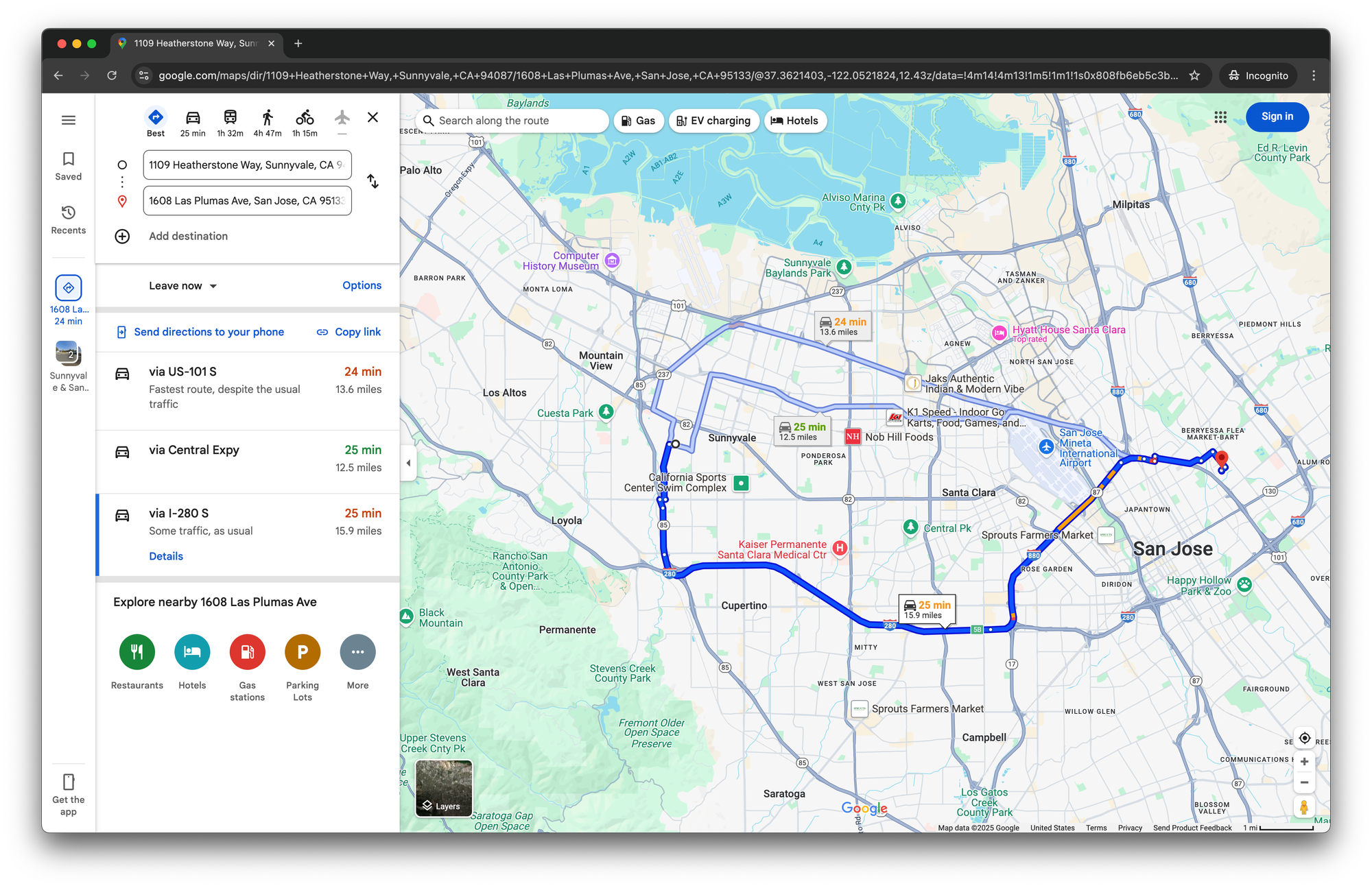
The so-called bet I lost was that most drivers' daily energy needs did not fill up each night from 0% to 100% state of charge (SOC), but rather a smaller amount of energy to drive the national average of 39 miles per day. To validate this idea, I commuted from Redwood to East San Jose for six months using only a level one outlet. Sven won the bet because, in those six months, I never needed to stop and use public charging during my daily commute to "opportunistically charge". While a level 1 outlet covered all my commuting miles, it was painfully slow, but it worked!
This bet made me rethink the problems that need to be solved to expand access to energy for a more sustainable future as electric transportation becomes the new normal. The world is undergoing a significant shift in how transportation and energy systems interact. As we witness accelerated EV adoption, the need for accessible, affordable, and reliable charging infrastructure becomes increasingly urgent.
However, in 2020, the charging landscape needed to be addressed, with a few large players focusing on fleets and public charging, leaving most charger sales for single-family homes to local electrical installers. The company was born out of a desire to solve one of the most pressing challenges facing EV owners—access to convenient energy, especially for those living in multifamily properties and workplaces.
This paper outlines why Orange needs to exist, focusing on four core problems: the accelerated growth of electric vehicles, integrating transportation with the grid, ensuring energy security, and mitigating environmental impact.
The Accelerated Growth of Electric Vehicles
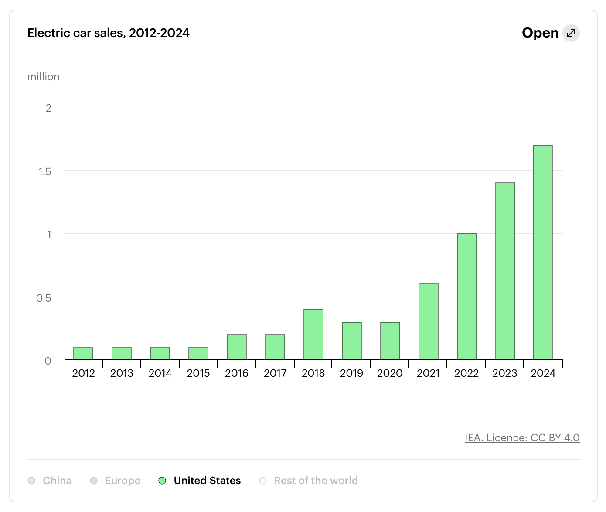
Source: https://www.iea.org/reports/global-ev-outlook-2024
Orange was founded primarily due to the rapid growth of electric vehicle (EV) adoption. Electric vehicles were adopted more rapidly than many had anticipated, but the charging infrastructure still needs to catch up. In 2020, Orange identified that while single-family homes could easily accommodate EV chargers by tapping into existing electrical systems, multifamily properties faced significant challenges. These properties, home to many urban dwellers, required additional infrastructure to support electric vehicle (EV) charging. The lack of reliable access to charging stations deterred many potential EV owners in these settings from making the switch.
EV owners often cite the convenience of waking up to a fully charged car as one of the major perks of owning an electric vehicle. However, this poses a challenge for many residents in apartment complexes, resulting in a clear divide between those who can charge their vehicles at home and those who cannot. With companies like Orange to bridge this gap, the full potential of EV adoption can be realized; residents in multifamily properties will be more inclined to opt for electric vehicles.
Coupling Transportation with the Electrical Grid
A second, more profound issue driving the need for Orange’s existence is the integration of transportation energy with the national electrical grid. In the past, transportation energy came from refined petroleum products distributed to local gas stations. With the increasing presence of EVs in the market, a new challenge has emerged: the shift towards drawing transportation energy from the electrical grid. This coupling means that, for the first time, electricity used for homes and businesses must also power vehicles, essentially doubling energy demand in numerous scenarios. For instance, in an apartment complex where residents consume a significant amount of energy, adding EV charging further strains the system, often necessitating costly service upgrades.
Orange has established itself as a company that solves this problem by optimizing energy management through intelligent charging solutions. Unlike traditional public Level 2 chargers found in multifamily properties, which often consume excessive power beyond drivers’ needs and necessitate costly infrastructure upgrades to meet rising demand, Orange’s innovative approach, particularly its power management systems, allows properties to add more charging stations without requiring these upgrades. By managing when and how EVs charge, Orange maximizes the use of existing energy infrastructure, reducing the need for disruptive and expensive service upgrades. This solution is crucial for scaling EV charging infrastructure at the rate necessary to support mass adoption of electric vehicles.
The Economic Viability
A third key reason for Orange’s existence is the economic burden that property owners face when installing EVs. This enables property owners to install more chargers without exceeding their budgets, thereby creating charging stations. For example, California has ambitious goals to install 1 million chargers by 2030. However, the current installation cost, often between $7,000 and $13,000 per parking spot, makes achieving this target difficult. Property owners, particularly in multifamily buildings, are unlikely to invest in charging infrastructure when the costs are so high, and the return on investment is unclear.
Orange addresses this by offering a more cost-effective solution. The charging outlets are designed to meet the daily needs of 99% of EV drivers while keeping installation costs as low as $2,000 per parking spot, significantly lower than those of traditional models. This cost reduction enables property owners to install more chargers without exceeding their budgets, thereby making EV charging infrastructure more accessible and scalable. Furthermore, Orange’s model enables property owners to recoup their investment through energy markup, creating a business model that excites rather than discourages them. By aligning the interests of EV owners and property developers, Orange has developed a system that can foster widespread EV adoption.
Many programs require governments to invest significant funds in incentivizing EV charging infrastructure in multi-family and disadvantaged communities. The issue lies in historical data showing that the average cost of installing a level 2 AC charger, which used to have a link on the CEC website breaking down the average price of incentive-based installations, ranges from $12,000 to $18,000 per charger.
| # of Parking Spaces | 1,000,000 | ||||
|---|---|---|---|---|---|
| Options | Avg Cost per Parking Space 400 ft Home Run | Total Cost For 1000000 Spaces | Savings over L2 EVSE | $/kWh | % Saved |
| L2 Hardwired EVSE (60A) | $ 17,804 | $ 17,804,000,000 | $ (7,524,000,000) | $ 1.55 | -73.19% |
| L2 Hardwired EVSE (40A) | $ 10,280 | $ 10,280,000,000 | $ - | $ 1.34 | 0.00% |
| NEMA 14-50R | $ 12,012 | $ 12,012,000,000 | $ (1,732,000,000) | $ 1.56 | -16.85% |
| NEMA 6-50R | $ 12,012 | $ 12,012,000,000 | $ (1,732,000,000) | $ 1.56 | -16.85% |
| NEMA 14-30R | $ 9,448 | $ 9,448,000,000 | $ 832,000,000 | $ 1.64 | 8.09% |
| NEMA 6-20R | $ 3,128 | $ 3,128,000,000 | $ 7,152,000,000 | $ 0.65 | 69.57% |
| NEMA 5-20R | $ 2,973 | $ 2,973,000,000 | $ 7,307,000,000 | $ 1.24 | 71.08% |
The table above outlines the installation costs for a commercial-grade circuit exceeding 400 feet, suitable for either an outlet or an EVSE. As states aim to use ratepayer funds to scale EV charging infrastructure, prioritizing installation costs is crucial and a primary concern.
For instance, California has set a goal to install 1 million chargers by 2030, with approximately 230,000 chargers already in operation over the last five years. By opting for a low-powered Level 2 charging solution, the states could save around $ 7.2 billion while targeting one million chargers within the next five years.
Orange started by developing a scalable, economically viable charging platform even without incentives. To achieve this goal, we recognized that energy is a tangible commodity, as significant as one of the fundamental physical resources of modern civilization. This means that capital expenditures (CAPEX) emerged as the primary variable controlling the payback period when all other variables and factors were constant.
Orange’s innovative solution delivers a remarkable 70% cost savings compared to 40-amp level 2 charging stations. This efficiency enhancement allows residents to connect more vehicles to charging points during working hours and overnight at home. Our approach saves money by eliminating the hassle of constantly moving cars around and the time wasted searching for an available charging station. It generates future value, enhancing the convenience of owning an electric vehicle.
Energy Security and Sustainability
Beyond addressing the immediate challenges of EV charging, Orange has a broader vision for its role within the energy ecosystem. Rather than simply being a charging provider, the company positions itself as an “access to energy” company.. As the world transitions toward a future powered by renewable energy sources such as solar, storage, and potentially nuclear energy, Orange is dedicated to promoting efficient and sustainable energy utilization by leveraging software within buildings.
The company’s dedication to optimizing energy utilization through demand response technology, such as charging vehicles during periods of lower demand and potentially exploring V2X technologies, showcases its commitment to a sustainable and secure energy future.
Moreover, Orange acknowledges that while renewable energy sources like solar power offer significant potential, the key challenge lies in effectively delivering this energy to end consumers. By addressing the “last mile” issue in energy delivery, particularly in urban environments with prevalent multifamily properties, Orange is pivotal in facilitating a seamless and practical energy transition for property owners, drivers, and utilities as they strive to adapt to evolving energy needs.
User Experience with Better Connectivity Architecture
Orange began examining the standards for EV charging in 2020, when many companies used Wi-Fi or cellular connections alone to connect chargers to charging stations and a centralized management system for access control and payments. We quickly encountered situations where chargers didn’t work as they struggled to establish a connection without adding thousands of dollars of networking gear to the garage. Even then, users often didn’t have a cell signal to connect to the cloud and start a charging session.
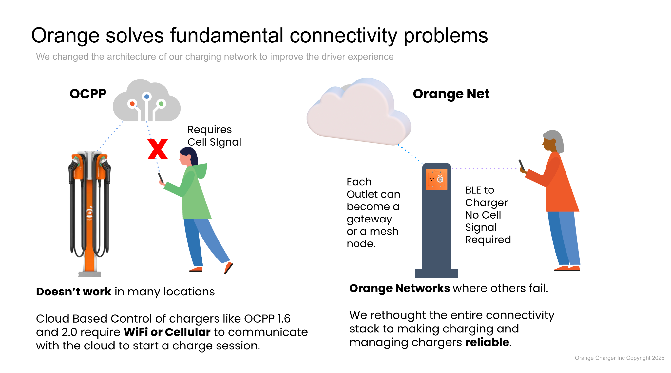
Underground parking structures and sizeable concrete parking garages quickly proved challenging— Orange set out to solve this problem by rethinking the network architecture of charging. To achieve the desired 99% successful charge session, compared to an industry average of 74%, (Add Source), we built our own IoT network and software architecture that uses a mesh network between chargers to get data and OTA updates while utilizing Bluetooth between users' mobile phones to start and stop charging sessions. In 2024, we achieved a 98.5% success rate across 24,000 unique charging events.
We are continually improving this technology by investing in our IoT stack to enhance how chargers store and manage data, authenticate users, and process payments. Unfortunately, to achieve this impressive success rate, we have had to move away from the industry’s poorly architected standards and sometimes don’t qualify for incentives. However, we believe that, in the long run, our decisions will prevail, as they save significant money during installation to network Orange chargers and improve the user experience far beyond what other vendors have achieved.
The Environmental Impact
We created Orange to expand the market, enabling more people to conveniently own electric vehicles and lead lifestyles that contribute to a sustainable economy. While we recognize the health benefits of electrifying more appliances and transportation to reduce emissions linked to illnesses like asthma and heart disease, we also believe that cleaner air, better energy use, and a resilient grid help slow the effects of emissions contributing to climate change. BloombergNEF has conducted extensive research over the years to understand a net-zero future, and numerous scientists have modeled the effects of emissions on greenhouse gas impact.
- CO2 Emissions Reduction from EV Adoption (2015-2022): The reduction in carbon dioxide (CO₂) emissions has increased significantly as more EVs hit the road, reaching an estimated 250 million metric tons of CO₂ reduced by 2022.
- NOx Emissions Reduction from EV Adoption (2015-2022): Nitrogen oxide (NOx) emissions, a significant contributor to air pollution and smog, have been reduced by 600,000 tons by 2022 due to the increasing adoption of electric vehicles (EVs).
Switching to electric vehicles has the potential to significantly improve air quality and reduce emissions, particularly in urban areas with high pollution levels, which often disproportionately affect marginalized communities. Governments encourage this shift through financial incentives, infrastructure developments, and regulatory measures. With the ongoing rise in adoption and the transition of energy grids toward renewable sources, the long-term environmental and public health benefits will be considerable for all individuals as electric vehicles become more widespread and accessible, thereby reducing energy costs.
Conclusion
Orange exists to address the pressing need for scalable, cost-effective, and efficient EV charging infrastructure, particularly in multifamily residential settings. Our solutions effectively address the logistical challenges of installing and maintaining charging stations and providing property owners with economically viable options. By optimizing energy use and reducing the need for costly infrastructure upgrades, Orange paves the way for widespread EV adoption without burdening the electrical grid. Companies like Orange play a pivotal role in ensuring that infrastructure development aligns with technological advancements as the global community transitions towards a more sustainable energy future.
Recent Writings

Could extended-range EVs encourage more car buyers to opt for full electric?
Problem: The fundamental idea here is that current EVs with 300-400-mile ranges still don't work for large SUVs that Americans actually buy. No actual pickup truck has been built that's comparable to an F150 or F250 capable of doing real work in the United States. This

A Founder’s Reflection of 2025
A founder’s reflection on leaving Orange, the collapse and rebirth of energy markets, and why AI and infrastructure are entering a new phase in 2026.

Zero to One Through Great Customer Discovery
Over the last several months, I've been helping several other founders who are early or have had to pivot from their original idea. Each time I encounter the same friction or resistance from founders, I have been there myself, facing the pushback of talking with customers and asking