Why Orange Had to Exist: The Origin Story
In 2020, I wasn’t trying to be a founder. I just wanted to solve a problem that was slowing the adoption of electric vehicles, and what was on the market wasn't scalable.
At the time, I was renting an apartment in a building that lacked EV charging facilities. I had worked on the Model 3 at Tesla and spent the last four years founding Lyt.ai, an AI traffic management company. While working on fundraising for Lyt, I became friends with Seve Thesen, Marc Geller, and Marc Taprneing, who all saw that the problem of getting access to energy for residents of multi-unit properties was almost impossibly complex and expensive.
For people living in single-family homes, adding a simple charger to the garage was easy enough, though not always economical. However, this access to overnight charging made owning an EV better than owning any other vehicle.
Property owners didn’t want to pay for installation. Tenants didn’t always have access to dedicated spots. Utilities weren’t helping with expensive and time-consuming service upgrades. Every solution we saw was built for the wrong customer: commercial fleets, single-family homes, or public parking lots. No one was solving for where most Americans actually live—multi-family housing.
So, we started Orange to scale EV charging to as many parking spaces as possible per dollar spent.
The vision was simple: make EV charging as easy and scalable as Wi-Fi. Something you could plug into your wall. Something tenants could activate and pay for. Something that didn’t require $100,000 in electrical upgrades. We didn’t want to build another charger—we tried to re-architect how charging infrastructure was deployed, managed, and monetized.
What I saw in 2020 was a market shaped by compromise.
- Chargers that required utility upgrades.
- Networks that broke under scale.
- Installations that made no financial ROI for landlords.
Orange needed to exist because:
- The existing model was broken. It was top-heavy, too slow, and far too expensive.
- EV adoption was going to outpace infrastructure. Especially in cities and dense housing markets.
- Property owners needed a business model. Not a charty project.
We took a fundamentally different approach:
- Chargers that work on existing power constraints.
- Plug-and-play architecture.
- A mesh network that doesn’t rely on Wi-Fi or cellular in underground parking.
- A mobile-first user experience for tenants.
- A dashboard for landlords that shows ROI—not kilowatts.
- A system that didn't break and requires ongoing maintenance.
This wasn’t just a hardware company. We were building a distributed energy platform to accelerate access to energy.
We developed Orange Outlet, a compact, affordable, power-efficient, and maintenance-free solution that enables property owners to provide access to energy in a scalable and economical manner.
The ecomics mattered, so we developed a business model for property owners and managers that would transform a money pit into a revenue-generating asset, attracting high-value residents to their properties.

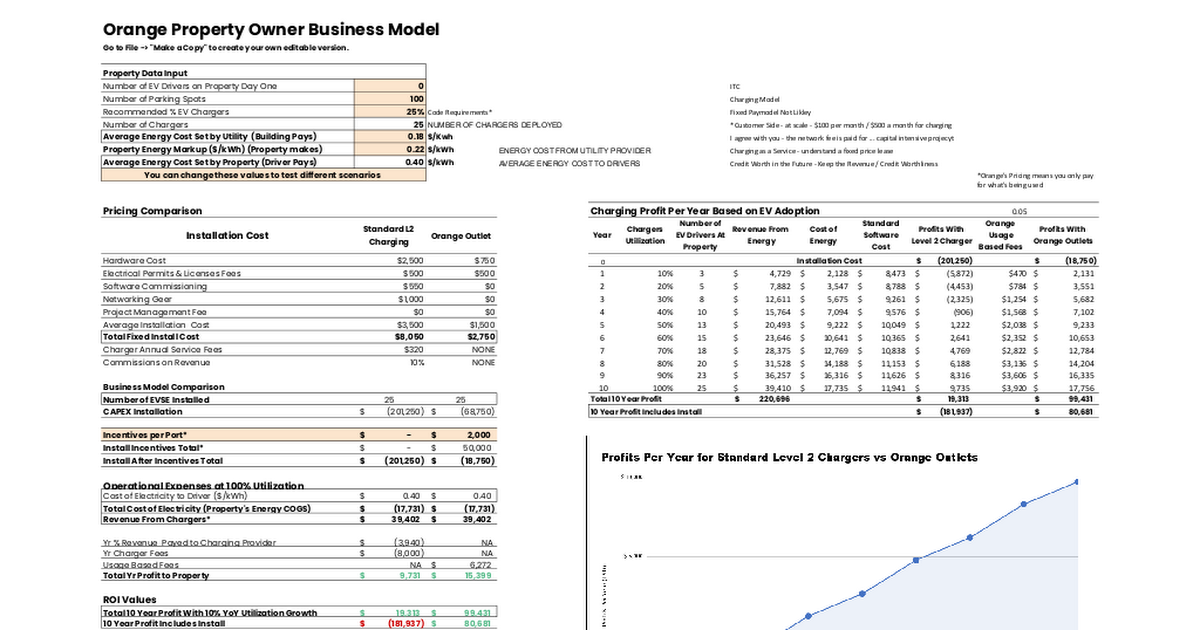
This simple business model turned EV charging from a loss leader to an ROI that was somewhat more attractive to property owners. This was just the beginning of the journey as we started developing.
With states like California working on new building codes that could require 50% of parking to be electrified, this mode is critical to ensure property developers can still build new developments in many cases. Let's take a moment to consider an example of how our solution solved these issues.
Property Example details,
- Number of units - 100
- Total parking space 130
- Average Rent $2000
Based on the above details, under the California proposed CalGreen codes, changes of 50% this property woudl require 50 chargers.
| Power | Outlet | L2 EVSE |
|---|---|---|
| Amperage Per Circuit | 20 A | 40 A |
| Power Per Circuit | 3.8kW | 6.6kW |
| Voltage | 208/240 | 208/240 |
This means for 50 chargers, the property would need an additional 330kW of power budgeted. This easily pushes developments into adding a new transformer and service with the utility, which can cost $100k+ and add delays that cost even more.
Compare this 330kW to Orange Outlets' 165kW, and you end up with half the power budget, often able to avoid adding a separate utility connection just for EV charging.
| Standard L2 Charging | Orange Outlet | |
|---|---|---|
| Hardware Cost | $2,500 | $750 |
| Electrical Permits & Licenses Fees | $500 | $500 |
| Software Commissioning | $550 | $0 |
| Networking Geer | $1,000 | $0 |
| Project Management Fee | $0 | $0 |
| Average Installation Cost | $3,500 | $1,500 |
| Total Fixed Install Cost | $8,050 | $2,750 |
| Charger Annual Service Fees | $320 | NONE |
| Commissions on Revenue | 10% | NONE |
With a highly technical team, we developed the hardware and software from the ground up, thereby avoiding complex installation and commissioning processes. Think of it as the Apple of EV charging. Each outlet features Wi-Fi, cellular, and Bluetooth capabilities, paired with a proprietary edge-computing-based software architecture rather than a cloud-based one. This means that the chargers work even if the signal is lost for several days. With the Orange app installed and an account set up, a driver can even start a charging session even if they don't have connectivity, a common issue with other chargers in underground parking structures often found in significant multi-family developments.
This build of networking into the charger and software architecture has another benefit. The property doesn't need to add Wi-Fi to the existing parking structure, saving not only the added hardware cost but also the installation and IT costs associated with setting it up. Most OPCC chargers require commissioning, which takes about 20 minutes per charger and requires a good network connection to work. Assume $150/hour for a low-voltage electrician to complete this task, and those 50 charges take 16 hours just to set up after installation, adding $ 2,400 in additional cost.
Unlike most EV providers that use OCPP activation standards, Orange deviated from the norm to deliver an exceptional user experience that saves on installation costs and provides better connectivity through Bluetooth between the phone and charger, ensuring seamless operation.
Orange was born from a deeply technical and deeply personal problem. I didn’t want another startup—I wanted to build the infrastructure I wished existed.
Orange had to exist. Because the future was already here, it just didn't have enough charging stations to plug in and charge effortlessly!
Stay tuned for more posts about how we scaled, what we learned, and what comes next. If you’re building in climate or energy—reach out. We need more people thinking differently.
Recent Writings

Could extended-range EVs encourage more car buyers to opt for full electric?
Problem: The fundamental idea here is that current EVs with 300-400-mile ranges still don't work for large SUVs that Americans actually buy. No actual pickup truck has been built that's comparable to an F150 or F250 capable of doing real work in the United States. This

A Founder’s Reflection of 2025
A founder’s reflection on leaving Orange, the collapse and rebirth of energy markets, and why AI and infrastructure are entering a new phase in 2026.

Zero to One Through Great Customer Discovery
Over the last several months, I've been helping several other founders who are early or have had to pivot from their original idea. Each time I encounter the same friction or resistance from founders, I have been there myself, facing the pushback of talking with customers and asking