Could extended-range EVs encourage more car buyers to opt for full electric?
Problem:
The fundamental idea here is that current EVs with 300-400-mile ranges still don't work for large SUVs that Americans actually buy. No actual pickup truck has been built that's comparable to an F150 or F250 capable of doing real work in the United States. This has left most electric vehicles in the small-to-medium car size range in America. While other markets, such as Europe and China, are content with smaller cars, the US's car size has grown significantly, making it challenging for EVs to establish a foothold in the large car segment due to efficiency issues and limited battery capacity.
Today, the status quo electric vehicle typically has a range of about 300-400 miles. The added cost is requiring either 100-150kWh of the pack to move an electric vehicle down the road for that number of miles. The true irony here is that most trips are less than 40 miles every single day, which means that the majority of actual EV owners are only using a fraction of their battery capacity every day and lugging around the weight and materials. This leads to extreme overuse of precious metals and materials locked inside batteries in thousands to millions of electric vehicles, which are used only a fraction of the time (maybe for long road trips or long days on the road).
The proposed solution here is to figure out a way to reduce the battery size so that the same number of batteries and the current limitations of battery capacity and manufacturing can build more vehicles, while eliminating range anxiety and the need for road-trippers to use DC fast charging more often, relying more on low-power Level 2 at-home charging at scale.
A paradigm shift can be quickly thought out. Let's actually work through the math and figure out what we're talking about.
What is the overall cost of DC fast charging in the United States? How much money have Tesla and other EV companies like Electrify America and EVgo spent on deploying an EV fast charging network? Could that money have been spent to install more at-home Level 2 chargers for more drivers across every single demographic? This includes multi-family, workplace, and home.
Next, let's look at the vehicle's overall cost. A majority of the cost of electric vehicles today is actually in the battery itself. All other cars have similar materials (doors, steering wheels, radios, technology, etc.). These things are fringe benefits of a vehicle and are relatively consistent across all vehicles. The primary difference between an electric vehicle and an internal combustion engine (ICE) vehicle lies in the powertrain. In a gas vehicle, the fuel is not purchased at the time of purchase, but is purchased throughout the vehicle's lifespan (filling up every few weeks). The challenge here is that the energy density is significantly higher than what battery packs can store.
To make this matter even more challenging, we aim to be a system that operates entirely on electricity. Meaning that for the majority of drive-hands, it's pulling energy from a battery or supercapacitor that is being recharged, not by an internal combustion engine but by some sort of generator. Think of a natural gas turbine or a petrol turbine that burns a little bit of fuel to generate electricity that then charges the battery at a steady state. We'll have to calculate the vehicle's steady-state motion at its extremes. This is usually around 70 to 80 miles per hour, where wind resistance becomes a significant factor in the car's speed and the amount of energy needed to keep it in motion. The other factors that are consistent across all vehicles are aerodynamics, rolling resistance, and tire-road friction. Otherwise, all vehicles are relatively the same, and therefore, the energy required to move them is a straightforward application of physics.

The challenge here is that the cost needs to be significantly lower than that of a battery-electric vehicle, and we don't believe battery costs will decrease to that level. Third, the actual user experience needs to be better, meaning that the overall requirements for a user are as close to the experience of an electric vehicle as possible, while reducing the need for DC fast charging every 2-3 hundred miles while road-tripping, and reducing the amount of time people spend getting from point A to point B. These two factors alone could significantly impact a user's experience with these vehicles. We would then assess the impacts of towing and determine whether we need a larger or smaller generator to meet our objectives.
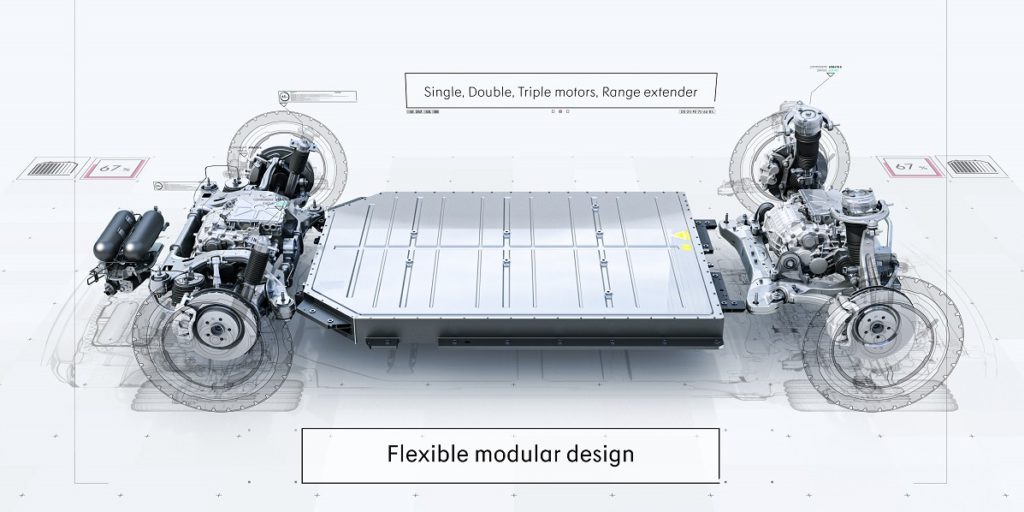
Zhejiang Geely Holding Group has launched its sustainable-experience architecture (SEA), which it claims is the world’s first open-source electric-vehicle (EV) platform. SEA will be deployed across the manufacturing group’s nine global automotive brands, beginning with Lynk & Co.
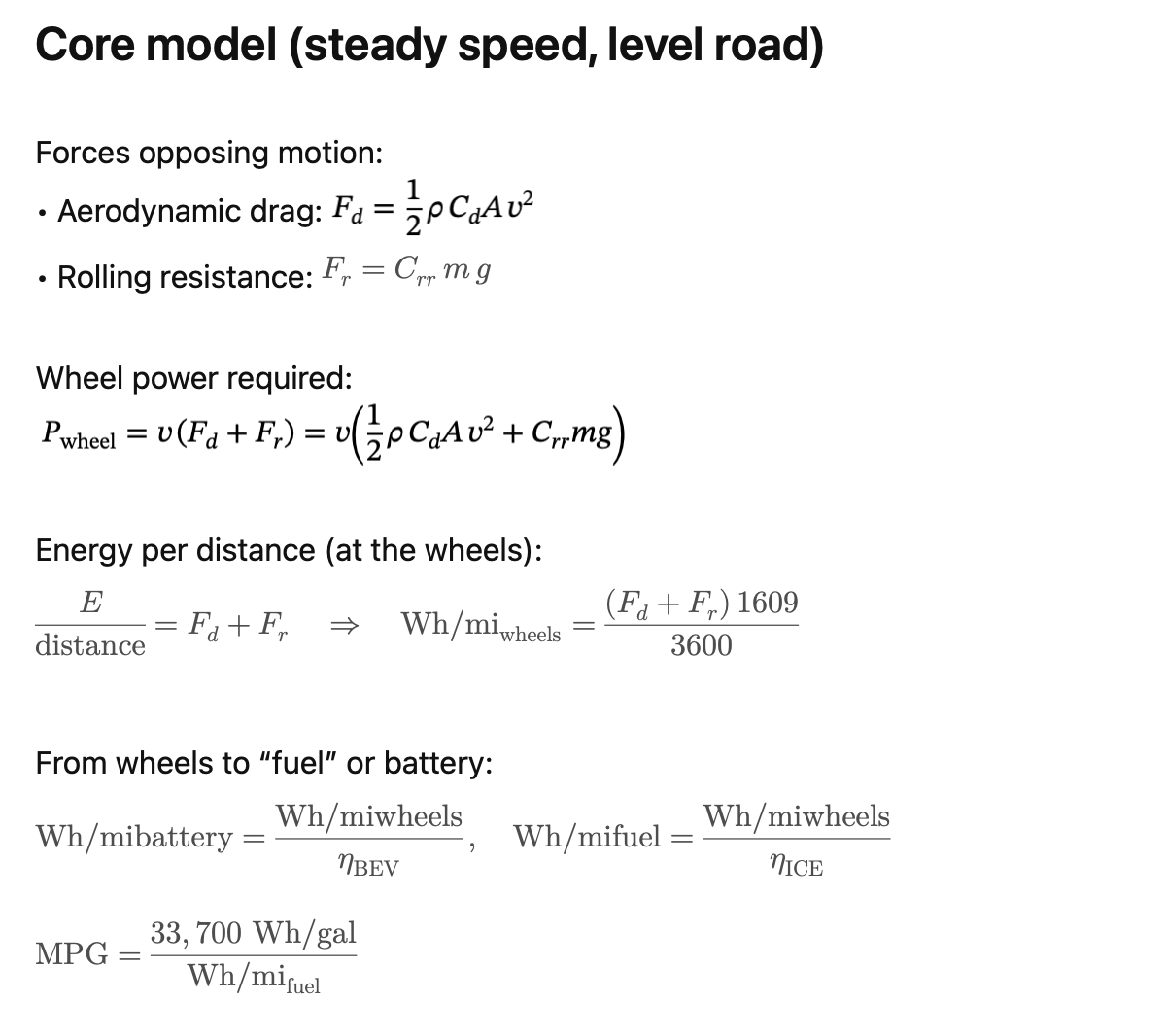
Based on this data, it's clear that several factors need to be considered. Once we understand the total watt-hours or kilowatt-hours per mile equivalent to MPG, we can understand both fuel and electric vehicles' energy needs. Regardless if the energy is coming from gasoline or electricity, the efficiency of electric motors is higher.
What we find is that about 2-400 watt-hours per mile is required. Therefore, we can work out 60-70 and 80 mile-an-hour averages that would need to be generated for every hour the car is driving. This means a generator would need to be in the 25-30 kilowatt range to generate the energy needed to keep a car at an optimal steady state without losing charge, say, at 70-80 miles per hour for long stretches of highway, assuming continuous generation during those times. The rest of the time, the car could either be recharging or recharging.
Average Energy used for EVs:
Average Energy Used for ICEs:
- Rav4
- CRV
- Expemidition
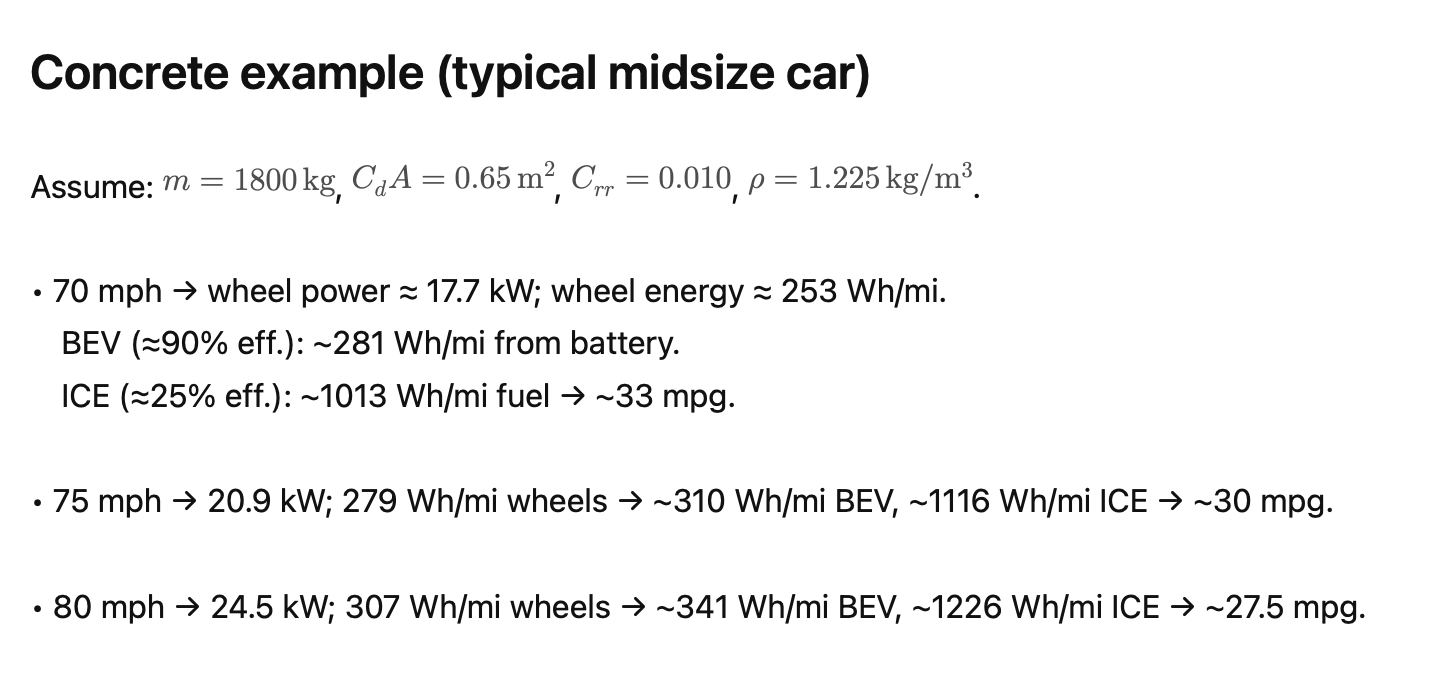
To calculate the energy consumption of a Ford Expedition in Wh/mile, you must first convert its fuel efficiency (in miles per gallon) to kilowatt-hours per gallon, then divide by 1,000 to get the watt-hours per mile (Wh/mile). This calculation is based on the vehicle's documented fuel consumption, rather than its physical characteristics.
Assumptions for Calculation
Fuel efficiency: A 2024 rear-wheel-drive (RWD) Ford Expedition averages 19 miles per gallon (combined city/highway).
Energy content of gasoline: One gallon of gasoline contains approximately 33.7 kWh of energy.
Engine efficiency: Gasoline engines are not 100% efficient. The average modern internal combustion engine has an efficiency of about 25%. For this calculation, we will use this value to represent the engine's conversion of gasoline energy to power.
Calculation of Wh/mile
Calculate the energy consumed per mile in kWh.
Divide the energy content of one gallon of gasoline (33.7 kWh) by the vehicle's miles per gallon (19 MPG).
33.7 kWh / 19 miles = 1.77 kWh/mile
Adjust for the engine's efficiency.
Divide the energy consumed per mile by the engine's efficiency (25%). This will give you the actual power the vehicle is using to move.
1.77 kWh/mile * 25% = 0.44 kWh/mile
Convert to Wh/mile.
Multiply the result in kWh/mile by 1,000 to convert to Wh/mile.
0.44 kWh/mile * 1,000 Wh/kWh = 440 Wh/mile
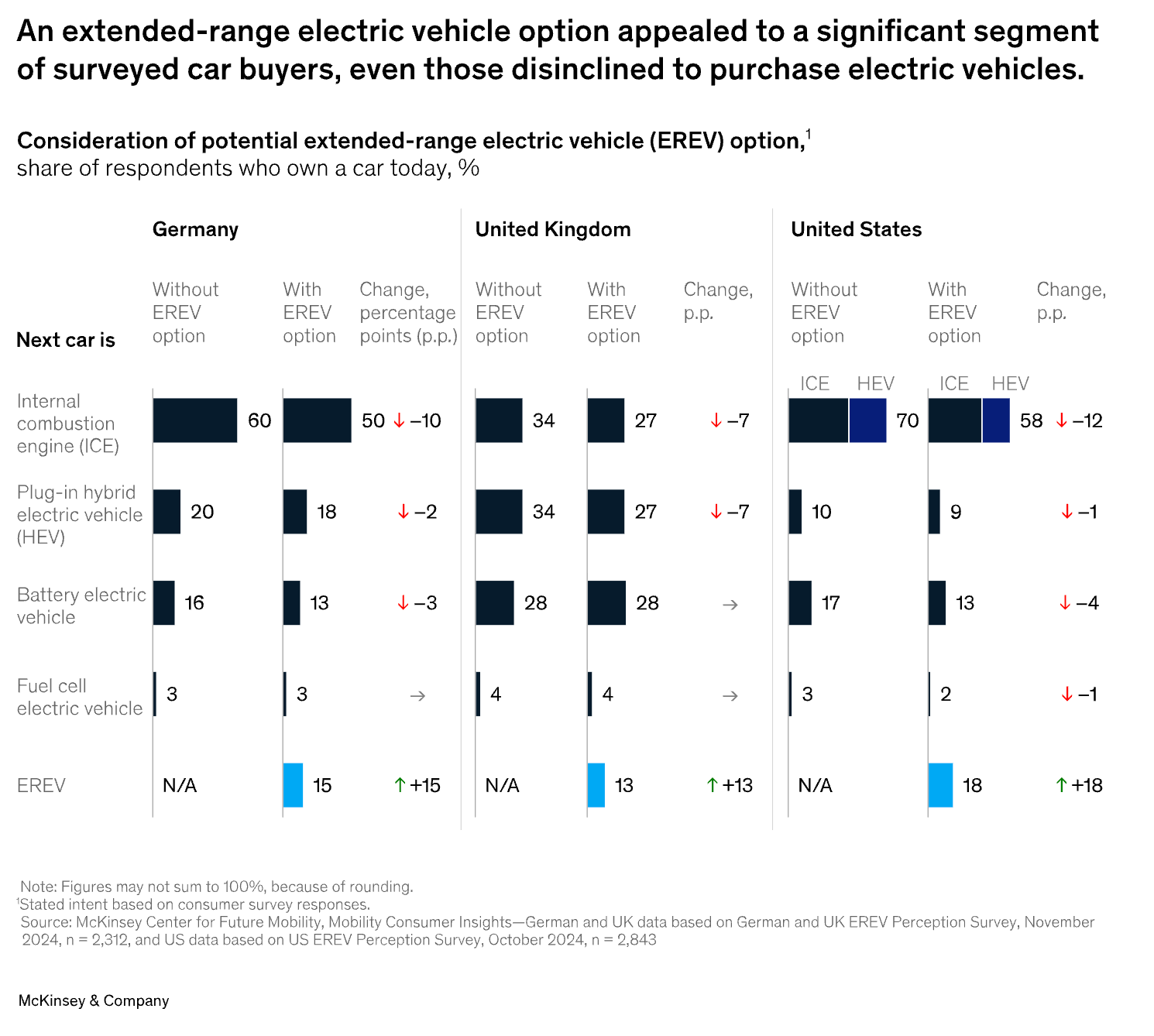
A key market segment that might embrace EREVs is EV owners who are considering switching back to an ICE due to frustration with inadequate charging availability and limited driving range in their current vehicles. In the 2024 McKinsey Mobility Consumer Pulse Survey, for example, 46 percent of US EV owners and 19 percent of European EV owners reported they were considering switching back to an ICE vehicle.6
Despite EREVs’ apparent appeal to a variety of car buyers, consumer education that clearly conveys the benefits of EREVs and generally demystifies the distinctions between all EV and hybrid-vehicle options is vital. Consumers have difficulty understanding how EREVs differ from PHEVs, BEVs, or other hybrid vehicles. Consumers in the United States appear to find the distinctions between different EV and hybrid powertrains especially perplexing. Among US car buyers included in McKinsey’s survey sample, nearly half (48 percent) agreed with the statement “I’m overwhelmed by the number of powertrains (currently available) to choose from.”7
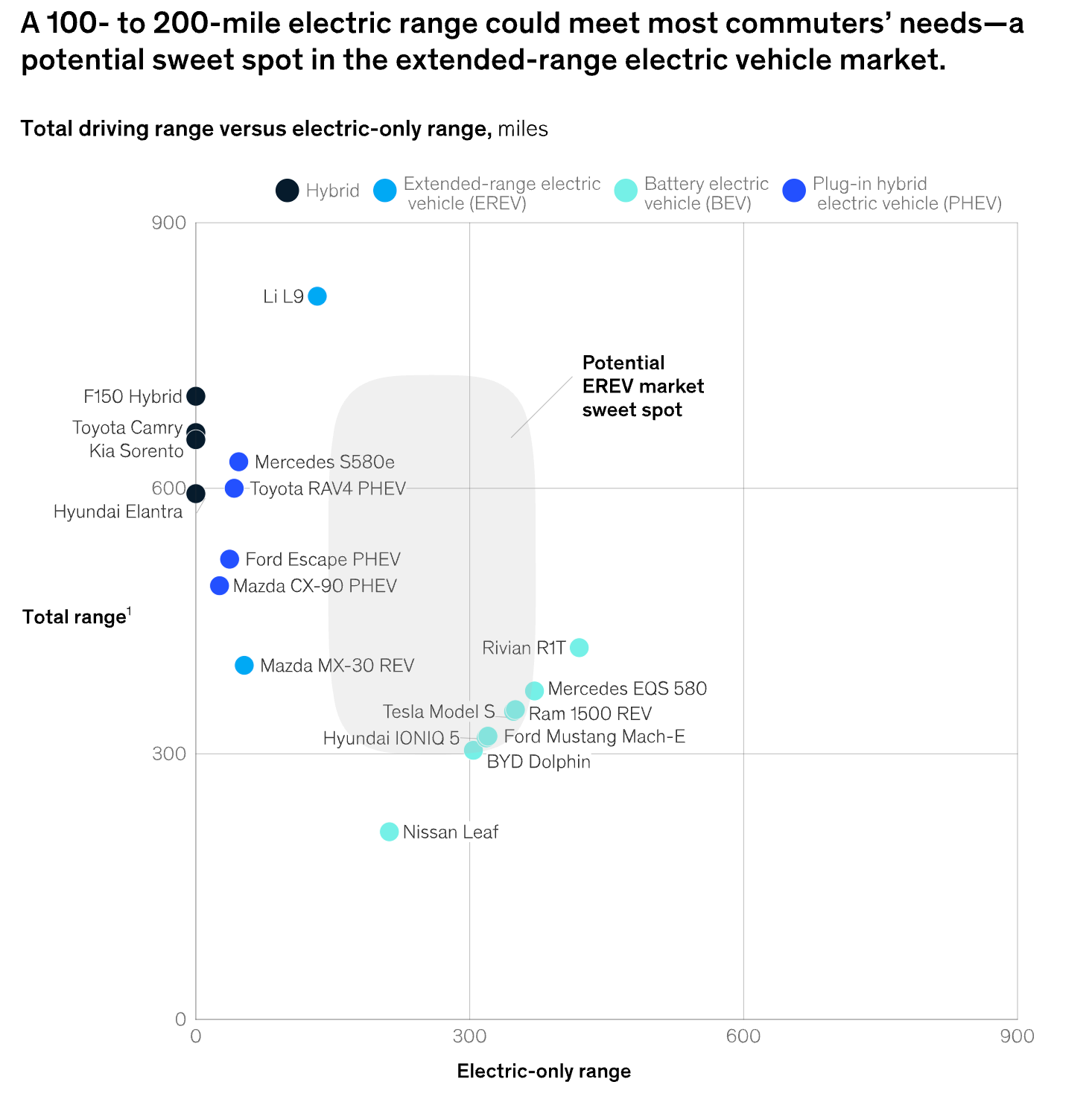
Currently, there are few EREVs in the global market. In the United States, EREVs in the SUV and truck segment have been announced, including the 2025 Ram 1500 Ramcharger, which reports a 145-mile pure electric and a 690-mile total driving range.8 In China, Li Auto has introduced several EREVs, including its L9, which reports a 134-mile electric range and an 817-mile total range.9 And AITO’s M9 reports a 140- to 170-mile electric and 840- to 871-mile total range.10 VW-backed Scout Motors has also announced several EREV models that, according to the company, have received considerably more deposits than their Terra and Traveler BEVs.11
An electric range of 100–200 miles would meet most drivers’ daily commuting needs, while a total range of 350–600 miles could eliminate range anxiety. This may indicate a sweet spot for the EREV market (Exhibit 2).
The zero-emissions vehicle deadline under current EU regulations means EREVs could be sold in the region through 2034. OEMs will need to consider their narrow window of opportunity in the EU and potential development timelines to determine whether consumer demand will generate enough profit to warrant investment in EREV powertrains. Notably, EREV powertrains may be a more future-proof option for OEMs than PHEV powertrains because they combine a BEV platform with a small ICE-powered generator that is not connected to the drivetrain.
Unlike the European Union, the United States has no zero-emissions requirement in place for new-car sales. At the federal level, Environmental Protection Agency standards tie compliance bonuses to electric driving ranges, which indicates a potential advantage for EREVs over PHEVs.12 For example, an EREV with a range of at least 70 miles could receive a 65 percent bonus in compliance standards, while a PHEV with a 25-mile range could receive a 30 percent bonus.13 The California Air Resources Board’s Advanced Clean Cars II rule does mandate 100 percent electrification in new cars sold by 2035, but one-fifth of those vehicles could be PHEVs or EREVs, and manufacturers could receive full credit for each vehicle with an electric range of at least 70 miles
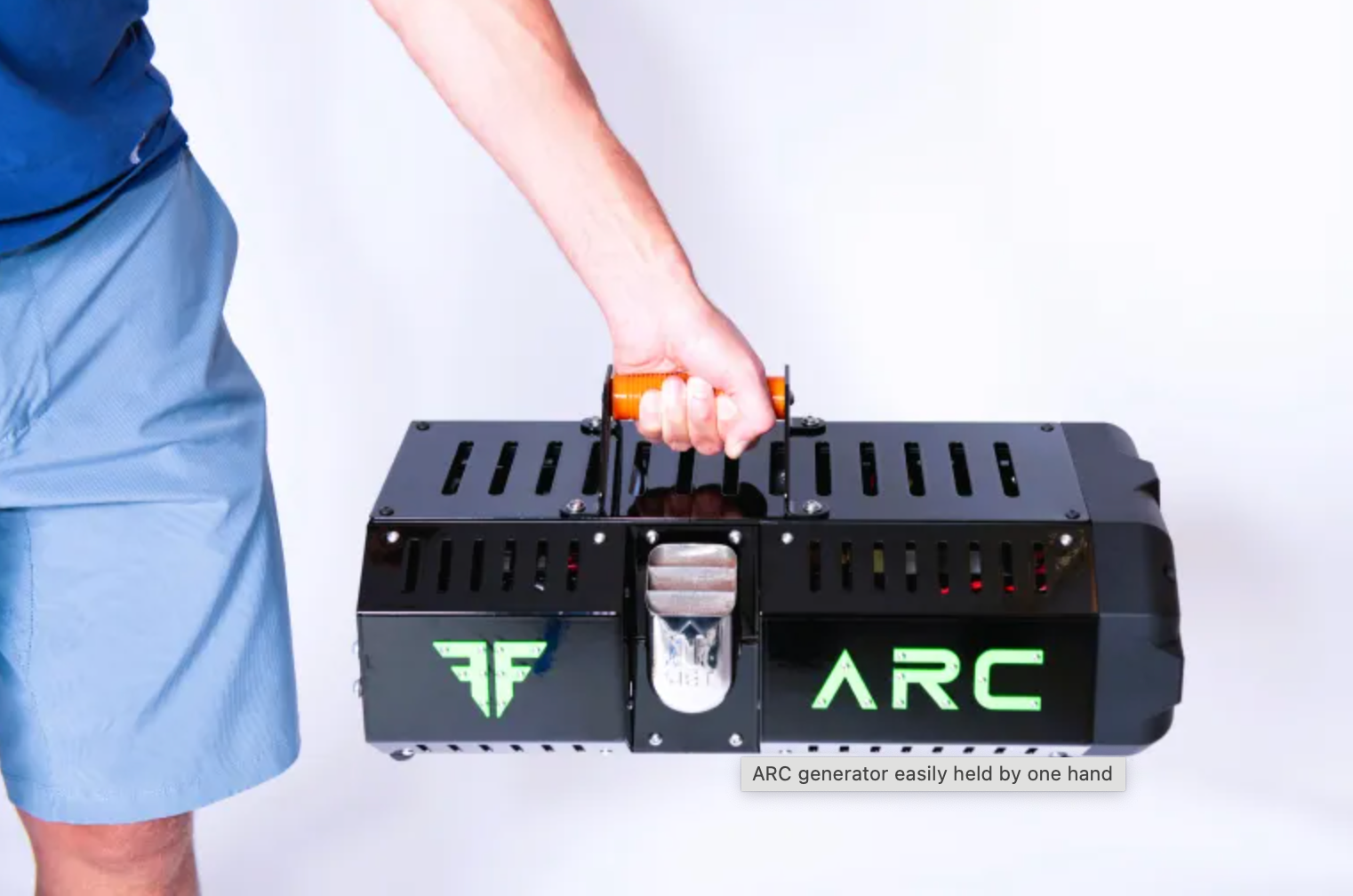
Options for Generators that are small enough to keep an EV charged while in motion, even when parked.
Should EVs with small petrol range extenders be more popular?
I recently read about and watched some videos on the new Mazda MX-30 R-EV in Europe. The new version fixes the range issue that the previous MX-30 had (I still don't understand why they designed the MX-30 with only 160 km of range) by using a small rotary engine that charges the battery while driving.
Now, this specific model, the rotary engine, isn't that great in MPG, but there has been another car that has used a similar range extender with a non-rotary engine - BMW i3.
Why isn't this concept more popular? This type of system could be a great way to be a middle ground in the EV/Petrol market, offering benefits that offset both sides.
You can build an EV, reducing the duplication/complexity of full-hybrid systems that use both gas and electric engines in tandem. As a full EV, you need little maintenance and less to go wrong.
Range extenders can be small, lightweight engines that only charge the battery and boost range. You get the electric benefits of an EV at short distances, but also the range advantages of gas power over longer trips without needing to recharge. This seems to address some of the range anxiety that arises when using charging networks.
By using a range extender, you can opt for a smaller battery, saving weight and cost (somewhat offset by the need to build a small engine for the car).
Now, the MX30 has other issues: crazy suicide doors, a small back seat, and the R-EV isn't even available in North America - but I would die for just a regular car with a similar concept.
https://www.reddit.com/r/cars/comments/1e1sz89/should_evs_with_small_petrol_range_extenders_be/
Conclusion
As of now, no generators on the market meet this exact need. We don't need a gas-powered engine, but a generator that can produce about 30-40 kW of continuous power from a small fuel supply. But adding the complexity of the system makes no logical sense compared to a pure battery-electric vehicle for most of the US market, and especially in Europe and China, where distances traveled are shorter.
That said, niche markets like trucking and large SUVs could benefit from range extenders.The overall market consensus, though, will be sentiment. How do you sell this as a better, cooler vehicle with more capabilities than the current status quo of pure battery-electric vehicles? Behavior is not based on numbers or logic.
Recent Writings

A Founder’s Reflection of 2025
A founder’s reflection on leaving Orange, the collapse and rebirth of energy markets, and why AI and infrastructure are entering a new phase in 2026.

Zero to One Through Great Customer Discovery
Over the last several months, I've been helping several other founders who are early or have had to pivot from their original idea. Each time I encounter the same friction or resistance from founders, I have been there myself, facing the pushback of talking with customers and asking
Three Quarters of Growth: What Orange Learned Building EV Charging for Multifamily
Context: A deep dive into Orange’s last three quarters—covering GTM execution, revenue growth, hardware challenges, and the unique dynamics of selling into multifamily properties. Focuses on business model design, utilization, connectivity, and why Orange’s approach is fundamentally different from traditional EVSE providers. Post Body: When we started